
2026 Latest NetSec-Architect Exam Dumps Recently Updated 67 Questions
Palo Alto Networks NetSec-Architect Real 2026 Braindumps Mock Exam Dumps
NEW QUESTION # 13
A global organization is modernizing its data center and private cloud infrastructure. The environment consists of:
- A Nutanix AHV cluster hosting critical east-west application workloads
- A VMware ESXi cluster with multi-socket hosts, supporting high-throughput workloads (>10 Gbps)
- A new pair of PA-5450 firewalls to secure the perimeter and handle encrypted traffic inspection at scale
- Strict performance service-level agreements (SLAs) for both north-south and east-west flows, with heavy reliance on TLS 1.3 and IPSec
- A Network Functions Virtualization (NFV) environment on KVM to provide high-performance security services to maximize packet throughput and minimize latency The chief architect is tasked with ensuring that the firewall design avoids hypervisor contention optimizes non-uniform memory access (NUMA) and uses hardware features for encrypted traffic.
VM-Series on Nutanix AHV - Resource Allocation
- Because the Nutanix cluster is already heavily used, the architect's main concern is preventing performance degradation of the virtual firewall. Thin provisioning or ballooning could introduce latency and unpredictability which is unacceptable for a security-sensitive workload.
VM-Series on VMware ESXi - NUMA and vCPU Placement
- In the VMware ESXi environment, the architect is deploying VM-Series for workloads pushing >10 Gbps. Assigning vCPUs across NUMA nodes or oversubscribing cores would create latency due to cross-socket memory access and scheduling delays. Similarly, dedicating logical hypethreads does not provide the deterministic data plane performance required.
Operational Integration and High Availability
- With performance guaranteed by correct hypervisor and hardware provisioning, the architect also considers high availability (HA). VM-Series pairs are deployed in active/passive HA across Nutanix and VMware clusters, while PA-5450s form the data center's north-south secure perimeter deployment. This ensures resilience without introducing unnecessary east-west inspection bottlenecks.
- The recommendation must be a scalable, high-performance firewall deployment aligned with enterprise SLAs and the CISO's encrypted traffic concerns.
Which resource allocation strategy should the architect use for the VM-Series virtual machine (VM)?
- A. Configure the VM with a high-priority setting in the AHV scheduler to ensure it gets preferential access to CPU cycles.
- B. Use thin provisioning for the VM's virtual disks to save storage space and allow for flexible growth.
- C. Implement CPU and memory reservation for the VM, pinning it to specific physical cores and reserving 100% of its allocated RAM.
- D. Enable memory overcommitment (ballooning) on the VM to allow the hypervisor to reclaim unused memory for other workloads.
Answer: C
Explanation:
Reserving CPU and memory while pinning the VM to specific physical cores ensures deterministic performance by eliminating hypervisor contention, avoiding NUMA penalties, and guaranteeing consistent access to resources. This approach aligns with high-throughput, low- latency requirements and is essential for maintaining predictable performance in security-critical workloads handling encrypted traffic.
NEW QUESTION # 14
A network experiences encrypted threats bypassing inspection. What is the BEST mitigation?
- A. Disable logging
- B. Use static routes
- C. Enable SSL decryption
- D. Block all HTTPS
Answer: C
Explanation:
SSL decryption allows inspection of encrypted traffic, revealing hidden threats. Blocking HTTPS is impractical, and disabling logging or adjusting routing does not address encrypted threat visibility.
NEW QUESTION # 15
Which factor must be taken into consideration when determining whether an NGFW edge architecture or a SASE architecture is appropriate to recommend to a customer planning to implement a Zero Trust Network Access (ZTNA) solution?
- A. ZTNA revolves around an agent on the endpoint and does not influence the overall NGFW or SASE architecture
- B. ZTNA requires User-ID and Group-ID information that is not available in Prisma SD-WAN
- C. ZTNA is a component of SASE and can only be implemented with Prisma Access
- D. ZTNA can be implemented regardless of the whether an NGFW or SASE solution is selected
Answer: D
Explanation:
Zero Trust Network Access is a security approach that can be implemented using either traditional NGFW-based architectures or SASE solutions. The key consideration is how identity, policy enforcement, and segmentation are applied, not the deployment model itself, since both architectures are capable of supporting ZTNA principles.
NEW QUESTION # 16
A global organization is modernizing its data center and private cloud infrastructure. The environment consists of:
- A Nutanix AHV cluster hosting critical east-west application workloads
- A VMware ESXi cluster with multi-socket hosts, supporting high-throughput workloads (>10 Gbps)
- A new pair of PA-5450 firewalls to secure the perimeter and handle encrypted traffic inspection at scale
- Strict performance service-level agreements (SLAs) for both north-south and east-west flows, with heavy reliance on TLS 1.3 and IPSec
- A Network Functions Virtualization (NFV) environment on KVM to provide high-performance security services to maximize packet throughput and minimize latency The chief architect is tasked with ensuring that the firewall design avoids hypervisor contention optimizes non-uniform memory access (NUMA) and uses hardware features for encrypted traffic.
VM-Series on Nutanix AHV - Resource Allocation
- Because the Nutanix cluster is already heavily used, the architect's main concern is preventing performance degradation of the virtual firewall. Thin provisioning or ballooning could introduce latency and unpredictability which is unacceptable for a security-sensitive workload.
VM-Series on VMware ESXi - NUMA and vCPU Placement
- In the VMware ESXi environment, the architect is deploying VM-Series for workloads pushing >10 Gbps. Assigning vCPUs across NUMA nodes or oversubscribing cores would create latency due to cross-socket memory access and scheduling delays. Similarly, dedicating logical hypethreads does not provide the deterministic data plane performance required.
Operational Integration and High Availability
- With performance guaranteed by correct hypervisor and hardware provisioning, the architect also considers high availability (HA). VM-Series pairs are deployed in active/passive HA across Nutanix and VMware clusters, while PA-5450s form the data center's north-south secure perimeter deployment. This ensures resilience without introducing unnecessary east-west inspection bottlenecks.
- The recommendation must be a scalable, high-performance firewall deployment aligned with enterprise SLAs and the CISO's encrypted traffic concerns.
While using the VM-Series to build the NFV environment, which configuration should the architect use?
- A. SR-IOV-enabled network interfaces and DPDK mode enabled
- B. Virtio drivers and DPDK mode enabled
- C. SR-IOV-enabled network interfaces and standard Linux bridge networking
- D. Virtio drivers connected to an Open vSwitch (OVS) bridge
Answer: A
Explanation:
For a high-performance NFV deployment on KVM, the VM-Series should use SR-IOV-enabled interfaces together with DPDK. Palo Alto Networks documents DPDK as improving packet- processing speed by bypassing the Linux kernel, and its KVM guidance explicitly calls out enabling both DPDK and SR-IOV for maximum VM-Series performance. This combination best fits the requirement to maximize throughput and minimize latency in an NFV environment.
NEW QUESTION # 17
An organization has selected Prisma SD-WAN ION devices for use at branch offices and is working to build a low-level design for its sites. A typical branch site has a 10 Mbps MPLS with fiber LC-SR, and an RJ-45 Ethernet 50 Mbps DIA internet circuit.
There are 75 workstations and a stacked core switch that supports LACP, M-LAG, BGP, and OSPF will be used. The core switch is the default gateway for all local VLANs. The final design will determine the selection of the appropriate model and accessories for the site.
Which statement applies to the Prisma SD-WAN architecture in this use case?
- A. Connectivity over the MPLS will be lost when the device that terminates it loses power
- B. MPLS underlay paths cannot be used as an active path alongside internet overlay path
- C. High availability (HA) for the LAN side connectivity can at most support two interfaces using LAG / LACP
- D. Only a default route can be advertised on a LAN-side BGP peering from the ION
Answer: A
Explanation:
In this design, the MPLS circuit is being terminated by the ION. If that device loses power, the MPLS path also goes down because the branch loses the device that is physically terminating and forwarding that private WAN connection. Prisma SD-WAN does support using private WAN and internet paths actively, so the issue is not coexistence of MPLS and DIA. It also supports LAN-side BGP beyond just advertising a default route, and LAG/LACP can bundle multiple LAN interfaces rather than being limited to only two.
NEW QUESTION # 18
A global organization is in the process of securing critical applications during a cloud-based migration while migrating to a cloud-first design, and it is currently performing a brownfield migration of its most critical applications - such as CRM and product intellectual property / design systems - into Azure Cloud. The organization already has an active/passive high availability (HA) NGFW deployed at its data center with multiple zones and has replicated that design into its existing Azure HA deployment.
The organization recognizes the need to modernize its security posture as critical workloads move out of the data center and users connect from anywhere. Its security model is defined by a traditional "hard shell, soft center" approach:
Zero Trust Gaps
- Current network segmentation is perimeter-based. The organization wants to expand Zero Trust principles across cloud and on-premises environments.
- The network relies heavily on VLANs and IP address-based Access Control Lists (ACLs) segmented primarily by office location and broad departmental groups.
- Once employees are on the corporate network (i.e., inside the "perimeter"), they have relatively wide access.
- If attackers compromise a single endpoint (e.g., via a phishing email), they can easily move laterally and scan for high-value targets.
Cloud Blind Spots
- The organization uses Azure for its production environments and hosts applications that contain sensitive customer data.
- Security controls in the cloud are often managed independently of the on-premises network.
Access is frequently granted with overly permissive identity and access management (IAM) roles and keys based on the resource rather than the user's real-time context or application health.
Remote User Access
- Many remote users are still hairpinning into the corporate data center just to reach internet or SaaS resources, creating latency and inefficiency.
- Traditional VPN is used for remote employees.
- The VPN grants access to the entire internal network segment making the remote endpoint the new, weaker perimeter. There is no continuous check on the user's device health after the initial connection.
Visibility and Logging
- Logs are primarily stored on-premises, then forwarded to a local Security Information and Event Management (SIEM) solution. As applications move to Azure, visibility into cloud traffic and user behavior becomes fragmented.
Data Security Concern
- Sensitive data, including product design files, will now live in SaaS and cloud environments. The organization needs data security to prevent leakage and enforce compliance.
Ingress Security
- Third-party partners and suppliers require access into the data center and cloud applications, introducing risk at ingress points.
The current Microsoft Azure NGFW architecture will not support the increased traffic with the new applications being migrated.
Which architectural solution will provide scalable inspection?
- A. Maintain the Azure active/passive design and use Azure scale sets to vertically scale the firewall size to handle all current and anticipated future east-west traffic.
- B. Keep the active/passive firewall only for north-south traffic and rely entirely on Azure Network Security Groups (NSGs) for east-west traffic inspection.
- C. Decommission the firewall pair and use a multi-region deployment of Azure VPN gateways to manage VNet-to-VNet connections.
- D. Migrate to a load balancer-based autoscaling firewall cluster that uses User-Defined Routes (UDRs) to traffic to multiple concurrent firewall instances for inspection.
Answer: D
Explanation:
A scalable Azure design for VM-Series uses load balancers with multiple active firewall instances rather than a fixed active/passive pair. Palo Alto Networks documents high-resiliency Azure deployments that use load balancers to distribute traffic across concurrent firewall instances, and Azure routing to the VM-Series relies on User-Defined Routes to steer traffic through the inspection path. That makes a load balancer-based autoscaling firewall cluster the correct architecture for increased cloud migration traffic and scalable inspection.
NEW QUESTION # 19
You must ensure high availability for critical firewall deployments. What configuration should you implement?
- A. Manual failover
- B. Active/Passive HA
- C. Static routing only
- D. Single firewall
Answer: B
Explanation:
Active/Passive HA ensures redundancy by maintaining a standby firewall ready to take over in case of failure. This minimizes downtime and ensures continuous protection, unlike manual failover or single-device deployments.
NEW QUESTION # 20
A global manufacturing organization has a strategic plan for rapid growth through mergers and acquisitions Several components the organization has purchased are deemed large deployments with existing IP address schemas and allocations that conflict with the parent organization. The manufacturing organization needs access to the resources before a re-IP initiative can be completed.
All of the deployments include a variety of IoT devices Leadership requires protection of vulnerable assets and identification of any known CVEs associated with the IoT devices. The governance, risk and compliance (GRC) team requires comprehensive non-repudiable logs to identify all IoT devices reporting "Critical (9 0+) CVE scores" for mandatory remediation.
Throughput needs to exceed the current 1 Gbps trending rate, and with expected growth will soon scale to 5 Gbps.
Segmentation is a mandatory requirement with enclaves based on region, device type, and function.
A firewall has been configured in tap mode for visibility into the traffic for profiling Inconsistencies in the profiling have been observed with a mix of behaviors.
What are two possible root causes for the behavior? (Choose two.)
- A. Asymmetric routing is providing visibility into TX but not RX traffic
- B. The devices are deployed behind a NAT device
- C. MAC spoofing is occurring on the network
- D. Hard coded MAC addresses cannot be properly profiled
Answer: A,B
Explanation:
When devices are behind a NAT device, multiple endpoints can appear as a single source, which reduces profiling accuracy and can cause mixed or inconsistent behavior to be attributed incorrectly. Asymmetric routing can also cause incomplete visibility because the firewall may see only one side of the conversation, preventing the profiling engine from observing the full traffic pattern needed for accurate identification.
NEW QUESTION # 21
A multinational organization has a large worldwide remote user base. This user base consists of several persona types with distinct requirements and concerns regarding the adoption of a Zero Trust Network Access (ZTNA) solution.
- Developers have a requirement to temporarily bypass security controls for business purposes, but the security team sees this as a potential risk. The developers commonly access development servers onsite in private data centers and public cloud. These development applications use web (HTTP/HTTPS), API, RPC, and SMB-based applications.
- Sales staff travel regularly and connect to the network via many different types of connections, but they are generally limited to SaaS-based web applications. They often complain about performance when any agent is installed and want the ability to temporarily disable these agents.
Data exfiltration and insider risk have been identified as the primary threats for this class of user.
- Executives have concerns about being high-value targets. Security must be consistent across the multiple endpoint types, including mobile and desktop devices. The executive team members have indicated that their primary objective is to ensure that the solution is responsive and easy to troubleshoot.
Which statement applies in the context of securing the developers' applications?
- A. GlobalProtect mobile users and explicit proxy users share the same configuration scope for policy configuration
- B. ZTNA Connector requires DNS for all applications it publishes and does not permit direct IP address-based access
- C. Explicit proxy on ramps can only provide security for HTTP, HTTPS, and proxy-aware applications
- D. Mobile users, remote networks, and explicit proxy all provide the same Cloud-Delivered Security Services (CDSS) capabilities.
Answer: C
Explanation:
Explicit proxy architectures are limited to HTTP/HTTPS and proxy-aware traffic, which means they cannot support non-web protocols such as SMB, RPC, or other application types commonly used by developers. Therefore, they are not suitable for securing the full range of developer applications in this scenario.
NEW QUESTION # 22
You need to ensure compliance reporting and audit visibility for firewall activities. What should you use?
- A. Disable logging
- B. NAT rules
- C. Log forwarding and reporting
- D. Static routing
Answer: C
Explanation:
Log forwarding and reporting provide visibility into firewall activity and support compliance requirements. They enable auditing, analysis, and integration with SIEM systems for centralized monitoring.
NEW QUESTION # 23
A global organization is modernizing its data center and private cloud infrastructure. The environment consists of:
- A Nutanix AHV cluster hosting critical east-west application workloads
- A VMware ESXi cluster with multi-socket hosts, supporting high-throughput workloads (>10 Gbps)
- A new pair of PA-5450 firewalls to secure the perimeter and handle encrypted traffic inspection at scale
- Strict performance service-level agreements (SLAs) for both north-south and east-west flows, with heavy reliance on TLS 1.3 and IPSec
- A Network Functions Virtualization (NFV) environment on KVM to provide high-performance security services to maximize packet throughput and minimize latency The chief architect is tasked with ensuring that the firewall design avoids hypervisor contention optimizes non-uniform memory access (NUMA) and uses hardware features for encrypted traffic.
VM-Series on Nutanix AHV - Resource Allocation
- Because the Nutanix cluster is already heavily used, the architect's main concern is preventing performance degradation of the virtual firewall. Thin provisioning or ballooning could introduce latency and unpredictability which is unacceptable for a security-sensitive workload.
VM-Series on VMware ESXi - NUMA and vCPU Placement
- In the VMware ESXi environment, the architect is deploying VM-Series for workloads pushing >10 Gbps. Assigning vCPUs across NUMA nodes or oversubscribing cores would create latency due to cross-socket memory access and scheduling delays. Similarly, dedicating logical hypethreads does not provide the deterministic data plane performance required.
Operational Integration and High Availability
- With performance guaranteed by correct hypervisor and hardware provisioning, the architect also considers high availability (HA). VM-Series pairs are deployed in active/passive HA across Nutanix and VMware clusters, while PA-5450s form the data center's north-south secure perimeter deployment. This ensures resilience without introducing unnecessary east-west inspection bottlenecks.
- The recommendation must be a scalable, high-performance firewall deployment aligned with enterprise SLAs and the CISO's encrypted traffic concerns.
Which PAN-OS feature will meet the CISO's need for north-south traffic inspection?
- A. Dedicated hardware crypto engines for offloading SSL/TLS decryption and IPSec processing
- B. High-density DAC/QSFP ports for flexible network connectivity
- C. Dedicated out-of-band management port for separating management and data traffic
- D. Dual redundant, hot-swappable power supplies for HA
Answer: A
Explanation:
Dedicated hardware crypto engines on the PA-5450 offload SSL/TLS decryption and IPSec processing from the main CPU, enabling high-performance inspection of encrypted north-south traffic. This ensures the firewall can meet strict SLAs while handling heavy TLS 1.3 and IPSec workloads efficiently.
NEW QUESTION # 24
A global organization has fully adopted Prisma Access to provide security for its mobile workforce and remote offices, and user identity is managed in Okta. The security team wants to create consistent Security policies that grant access to specific SaaS applications based on a users' departments, regardless of whether they work from home or a from branch office connected via an SD-WAN device. Which architecture ensures that consistent user-to-group mapping is available to Prisma Access for policy enforcement in this use case?
- A. Configure each remote office SD-WAN device and each user's GlobalProtect client to query Okta directly for user information
- B. Configure SAML federation between Prisma Access and Okta to provide user identity for every web request
- C. Install the Palo Alto Networks User-ID agent and configure it to sync user information from Okta to Prisma Access
- D. Deploy Panorama to manage Prisma Access and configure it to pull user and group information from Okta via the Cloud Identity Engine
Answer: D
Explanation:
Panorama-managed Prisma Access integrates with Cloud Identity Engine to retrieve user and group information for both mobile users and remote networks, which allows consistent user-to- group mapping across work-from-home users and branch offices. Cloud Identity Engine supports Okta as the identity source, so department-based group membership from Okta can be used centrally for Prisma Access policy enforcement.
NEW QUESTION # 25
An organization has a directive to adopt a Zero Trust framework focused on using identity and role-based access groups, device security and content inspection across all Security policies. To achieve this goal, an Enterprise License Agreement (ELA) was purchased, including Advanced Threat Prevention, IoT Security, and GlobalProtect.
The current security architecture uses Panorama to manage 60 NGFWs - a mix of PA-3240, PA-1410, and PA-440. Sites with PA-3240s host private application resources in the trust data center zone All sites have an untrust zone for internet access and a users zone for managed and unmanaged endpoint devices. A transit mesh zone exists to establish site-to-site connectivity through PAN-OS SD-WAN.
Privately hosted applications include web servers, SMB and NFS file servers and hosted Active Directory. The organization is in the process of adopting group mapping restrictions to these private applications, with daily additions of groups. It is also planning to build AI applications to assist the data teams with complex queries that will be hosted in the large offices containing data centers and is exploring hosting in the public cloud.
The organization uses on-premises Exchange, Dropbox, Zoom, and ChatGPT. There are a number of shadow SaaS applications that require further investigation. Users have been using Google Drive to upload confidential files within the organization by using their personal logins.
IoT devices on the network are associated on their own VLAN on the users zone. Using Device Security, all IoT devices have been categorized by asset profiles with medium or high confidence, policy sets imported into Panorama, and a default deny applied to the IoT networks.
The organization has rolled out SSL decryption and is using URL categorization for the majority of content filtering. Malicious categories, unknown and high-risk websites are blocked, with the remainder of sites set to alert.
Which deployment method should the architect suggest for enabling User-ID based rules, restricting or allowing access as close to the source as possible, while minimizing operational overhead?
- A. Cloud Directory via SCIM to sync user groups to the Cloud Identity Engine and the firewalls
- B. Cloud Identity agent to sync user groups to the Cloud Identity Engine and the firewalls
- C. Panorama device template with a group mapping profile with group allow list to reduce group update time on the firewalls
- D. Panorama device template for data redistribution, referencing primary and secondary Panoramas as the User-ID agent
Answer: B
Explanation:
The Cloud Identity Engine uses a lightweight Cloud Identity Agent for on-premises directories, while SCIM is for cloud-native identity providers. In this environment, the organization hosts Active Directory on-premises and needs scalable, centralized user and group synchronization for many firewalls with low operational overhead, so deploying the Cloud Identity Agent to sync user groups to the Cloud Identity Engine and the firewalls is the best fit.
NEW QUESTION # 26
An architect is reviewing a use case with the following requirements:
- Visibility on the health of an end user's path for the five most
critical applications
- Metrics on the impact of endpoint health for application
- Centralized call quality analytics from Zoom video conferencing
solution
- Insights into the supporting protocols, such as DNS
- Support 600 users on Windows desktops in a single sales office
Which solution should be recommended to meet these requirements?
- A. Prisma Browser or the Prisma Browser extension with RUM metrics
- B. Prisma SD-WAN using the native application dashboard and link quality monitoring
- C. Remote networks with ADEM enabled and an ION device
- D. GlobalProtect with a Prisma Access portal configured and ADEM enabled
Answer: C
Explanation:
ADEM with a remote network and an ION device is the best fit for a single office deployment because it provides end-to-end visibility for branch users and applications, including path monitoring for critical apps and insight into supporting services such as DNS. Palo Alto Networks also states that ADEM for remote sites is supported on Prisma SD-WAN remote sites with ION platforms, and ADEM's Zoom integration delivers centralized meeting quality analytics correlated with network and endpoint factors. This aligns with the requirement to monitor user experience for a 600-user Windows-based sales office from a centralized view.
NEW QUESTION # 27
An architect must design secure remote access for users. Which solution is MOST appropriate?
- A. NAT only
- B. GlobalProtect
- C. VLAN segmentation
- D. Static routing
Answer: B
Explanation:
GlobalProtect provides secure remote access with user authentication, device posture checks, and policy enforcement. It ensures secure connectivity compared to basic network configurations.
NEW QUESTION # 28
A cloud engineer has implemented a security solution with a VM-Series firewall in a GCP centralized VPC to secure traffic between two spoke VPCs, but there is no communication between the spokes. Which missed implementation step may cause this behavior?
- A. Specific no-NAT policy rule for traffic between the spoke CIDR ranges
- B. Source NAT policy for traffic initiated from one spoke to the other
- C. Peering connection between the two spoke VPCs
- D. Security policy rule allowing inter-spoke traffic
Answer: D
Explanation:
In the GCP centralized hub-and-spoke design, traffic between spoke VPCs is steered to the internal load balancer in the hub VPC, then inspected and forwarded by the VM-Series firewall through its trust interface to the destination spoke. That means spoke-to-spoke communication depends on the firewall being configured to permit that inter-spoke traffic after inspection. Direct peering between the spokes is not required in this architecture.
NEW QUESTION # 29
An organization uses Microsoft Entra ID and wants to strictly enforce a requirement that remote users accessing highly sensitive SaaS applications can only do so when originating from Prisma Browser. Which unique identifier must be configured within the Entra ID Conditional Access policy to effectively confirm and enforce that the access request is specifically originating from Prisma Browser and preventing standard web browsers from circumventing the Zero Trust Network Access (ZTNA) control?
- A. Unique device token or Device-ID issued by Prisma Browser and validated by Entra ID
- B. Certificate thumbprint of Prisma Browser's secure workspace key used for session encryption
- C. GlobalProtect mobile application installed on the user's endpoint
- D. List of known egress IP addresses associated with Prisma Browser's cloud proxy infrastructure
Answer: A
Explanation:
Prisma Browser provides a unique device identity signal that can be integrated with Microsoft Entra ID Conditional Access. This device token (Device-ID) allows Entra ID to verify that the session originates specifically from the Prisma Browser environment, enabling strict enforcement that only sanctioned browser instances can access sensitive SaaS applications.
NEW QUESTION # 30
A technology company is deploying its own AI applications on a Google Kubernetes Engine (GKE) cluster. The development team is concerned about protecting the complex, microservices- based AI stack from both internal and external threats: such as data poisoning and lateral movement between containerized components. Which solution should be proposed to address these concerns?
- A. AI Access Security with App-ID Cloud Engine
- B. Prisma AIRS Network Intercept
- C. Prisma AIRS API Intercept
- D. AI Access Security with Advanced URL Filtering
Answer: B
Explanation:
Network Intercept provides visibility and enforcement on east-west and north-south traffic within Kubernetes environments, allowing inspection of communications between microservices. This enables detection and prevention of threats such as lateral movement and data poisoning by analyzing runtime network behavior inside the AI application stack.
NEW QUESTION # 31
You must protect against command-and-control traffic using DNS tunneling. Which feature helps MOST?
- A. VLAN
- B. DNS Security
- C. NAT
- D. URL filtering
Answer: B
Explanation:
DNS Security detects malicious DNS patterns, including tunneling and C2 communication. It provides advanced analytics beyond simple URL filtering.
NEW QUESTION # 32
An organization plans to deploy a full SASE architecture consisting of Prisma SD-WAN IONs at branches and data centers alongside Prisma Access remote networks, service connections, and mobile users. The business office team requires that traffic from global remote offices to public cloud is of highest criticality, and this traffic should have the greatest service-level agreement (SLA) and QoS priority while still maintaining a balance of threat inspection. Which recommendation should the architect make to provide the lowest latency, highest throughput, and greatest resilience for the applications?
- A. Prisma Access remote networks with service connections directly to the cloud environment using IPSec and either static or dynamic routing
- B. Prisma Access Agent or a PAC file explicit proxy configuration connecting the end user devices directly to Prisma Access with a service connection to the public cloud provider
- C. Prisma SD-WAN IONs deployed within the cloud environment using BGP-to-peer to the internal route tables of the application
- D. Prisma SD-WAN ION deployed at both branch and private data center with a direct private link between the private data center and the public cloud provider
Answer: C
Explanation:
Deploying Prisma SD-WAN IONs in the public cloud gives remote offices the most direct path to cloud-hosted applications, which is the best fit for lowest latency and highest throughput. Prisma SD-WAN is built around application-aware path selection, QoS, and performance policy so traffic can be prioritized by business criticality and moved to a better path when SLA metrics such as latency, loss, or jitter are violated. Palo Alto Networks also supports BGP on branch and data center ION devices, including public-cloud deployments through its cloud integrations, which provides resilient routing to cloud application environments.
NEW QUESTION # 33
An organization is in the process of building a network infrastructure that is cloud first. Part of the revised architecture includes Prisma Access as demonstrated in the diagram below. The organization has selected Strata Cloud Manager (SCM) as the management method for Prisma Access and NGFWs deployed at the data center and in public cloud environments. There are 150 NGFWs in place that are used to terminate service connections and segment networks as well as to secure the data center and public cloud resources.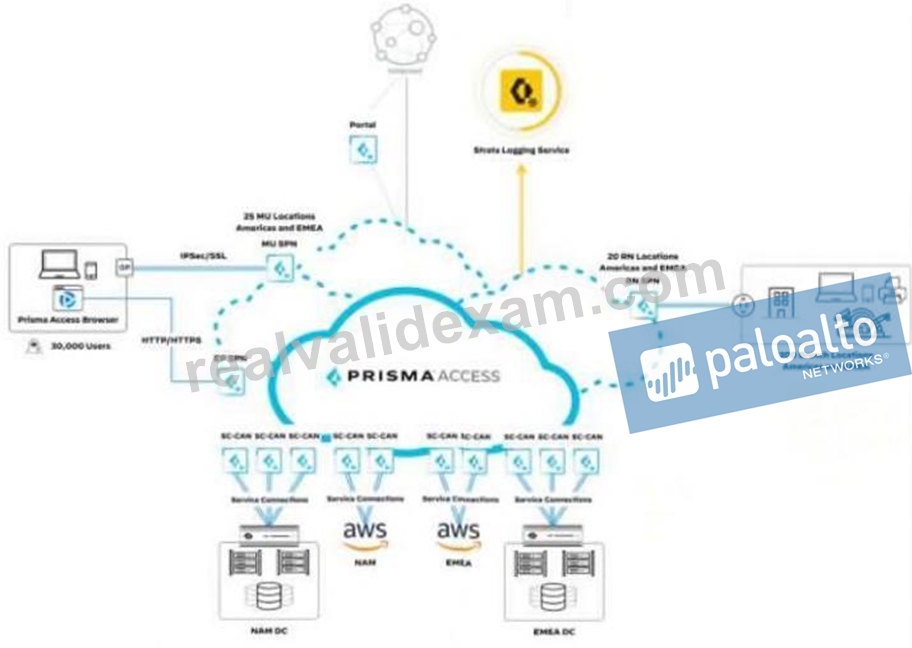
One of the resilience requirements is to provide highly available directory services and authentication for the NGFW and Prisma Access deployment.
The organization wants to be able to track Prisma Access users on the on-premises firewalls and remote networks.
Which configuration meets the design and organization requirements?
- A. Firewalls will connect to each node of a Panorama high availability (HA) pair to retrieve user information, and remote networks will receive the user context from the Cloud Identity Engine
- B. Each firewall and remote network will be configured to retrieve user information from each of the Prisma Access SC-CANs.
- C. Firewalls will connect to a regional set of redistribution firewalls connected to the SC-CANs and RN-SPN will connect to each SC-CAN to retrieve the user information
- D. Each firewall and remote network will be configured to retrieve user information from each of the Prisma Access MU-SPNs
Answer: A
Explanation:
Panorama distributes user-to-IP mapping information to on-premises firewalls through User-ID redistribution, while Prisma Access remote networks obtain user context from the Cloud Identity Engine. This combination ensures consistent and highly available user visibility across both on- premises NGFWs and Prisma Access environments.
NEW QUESTION # 34
A company requires segmentation between development, testing, and production environments.
What is the BEST design?
- A. Same zone for all
- B. Static routes
- C. Separate zones with security policies
- D. VLAN only
Answer: C
Explanation:
Using separate zones with enforced security policies ensures proper segmentation and control between environments. VLANs alone do not provide security enforcement without firewall policies.
NEW QUESTION # 35
A large organization uses Palo Alto Networks VM-Series firewalls deployed across multiple availability zones in Microsoft Azure. These are managed by an Azure Virtual Machine Scale Set (VMSS) and integrated with an Azure Load Balancer for high availability (HA) traffic inspection within a Transit VNet.
The security team needs to perform a critical PAN-OS software upgrade across the entire fleet of firewalls with the requirement of minimal application downtime.
Following Palo Alto Networks best practices for highly available cloud deployments, what is the recommended approach for safely performing this software upgrade with the least downtime?
- A. Provision a new, parallel VMSS with the new PAN-OS version, validate it, and redirect traffic from the old VMSS to the new one
- B. Use Azure Update Manager to push the PAN-OS upgrade package directly to all firewall instances simultaneously during a scheduled maintenance window
- C. Configure Azure Load Balancer probes to handle the health check failover during upgrades
- D. Update the image in an Azure VMSS and then initiate an upgrade of the instances
Answer: A
Explanation:
The safest approach with the least downtime is a blue/green-style replacement: build a new parallel VMSS running the target PAN-OS version, validate it fully, and then redirect traffic from the old scale set to the new one. Palo Alto Networks documents creating custom Azure VM- Series images for the exact PAN-OS version you want to deploy, which supports standing up a separate validated fleet rather than in-place upgrading the active inspection path. Azure health probes help determine instance health during updates, but they do not remove the risk of service disruption from upgrading the live fleet in place.
NEW QUESTION # 36
......
Verified NetSec-Architect Exam Dumps Q&As - Provide NetSec-Architect with Correct Answers: https://officialdumps.realvalidexam.com/NetSec-Architect-real-exam-dumps.html
