
[Jan-2024] Oracle 1z0-1056-23 Official Cert Guide PDF
Exam 1z0-1056-23: Oracle Financials Cloud: Receivables 2023 Implementation Professional - RealValidExam
Oracle 1z0-1056-23 Exam Syllabus Topics:
| Topic | Details |
|---|---|
| Topic 1 |
|
| Topic 2 |
|
| Topic 3 |
|
| Topic 4 |
|
NEW QUESTION # 10
You are investigating the Receivables to General Ledger Reconciliation report and must explain any variances to your Accounting Manager.
What two variance amounts should you expect to investigate in this report?
- A. Tax Variance
- B. Accounting Variance
- C. Intercompany Variance
- D. Receivables Variance
Answer: B,D
Explanation:
Explanation
These are the two variance amounts that you should expect to investigate in the Receivables to General Ledger Reconciliation report. Accounting variance is the difference between the subledger journal entries and the general ledger journal entries. Receivables variance is the difference between the subledger balances and the general ledger balances. Verified References: [How You Reconcile Receivables to General Ledger - Oracle]
NEW QUESTION # 11
Manage Receipt Classes and Methods
Scenario
Supremo US Business unit needs to capture customer payments that will be reconciled in the Cash Management application. You need to define a receipt class and receipt method, and assign the appropriate bank account to meet this requirement.
Task:
Define Remittance Bank Account where:
* Bank Account is associated with Receipt Method
* Primary bank account is linked the Denver branch of Bank of America
* Bank account number ends with 2870
* Remittance bank account is effective as of January 1, 2023
* GL Accounts section must contain the values below for company segment 120 Supremo Fitness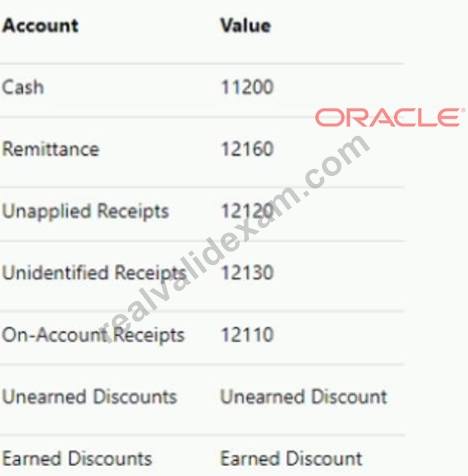
Answer:
Explanation:
See the explanation below for solution.
Explanation
* Log in to Oracle Financials Cloud.
* Click on the Remittance Bank Accounts icon in the Receivables work area.
* Click on the Create button.
* In the Remittance Bank Account window, enter the following information:
* Name: XXRemittance Bank Account (Replace XX with your allocated user ID.)
* Bank Account Number: The bank account number that you want to associate with the receipt method.
* Bank Name: Bank of America
* Branch Name: Denver
* Account Type: Checking
* Effective Date: January 1, 2023
* Primary: Yes
* GL Accounts:
* Company Segment: 120 Supremo Fitness
* Account Code: 12000
* Account Name: Accounts Receivable - Supremo Fitness
* Company Segment: 120 Supremo Fitness
* Account Code: 12001
* Account Name: Allowance for Doubtful Accounts - Supremo Fitness
* Click on the Save button.
The new remittance bank account will be created.
NEW QUESTION # 12
Which flexfields does Autolnvoice require to identify transactions and transaction lines, if you load the interface using a customized form?
- A. Line-level transaction flexfield and Header-level transaction flexfield
- B. Line-level transaction flexfield. Header-level transaction flexfield. and Link to transaction flexfield
- C. Line-level transaction flexfield. Header-level transaction flexfield. and Reference flexfield
- D. Line-level transaction flexfield, Invoice transaction flexfield. Reference flexfield. and Link to transaction flexfield
Answer: A
Explanation:
Explanation
These are the two flexfields that AutoInvoice requires to identify transactions and transaction lines, if you load the interface using a customized form. They are used to group transaction lines into transactions and assign transaction attributes. Verified References: [How You Define AutoInvoice Grouping Rules - Oracle]
NEW QUESTION # 13
Manage Receipt Classes and Methods
Scenario
Supremo US Business unit needs to capture customer payments that will be reconciled in the Cash Management application. You need to define a receipt class and receipt method, and assign the appropriate bank account to meet this requirement.
Task:
Create a manual Receipt Class, where:
* Name of the new receipt class is XXReceipt Class (Replace XX with 03, which is your allocated User ID.)
* Receipts using this new receipt class will not be remitted
* Organization will use Cash Management to clear their receipts
Answer:
Explanation:
See the explanation below for solution.
Explanation
* Log in to Oracle Financials Cloud.
* Click on the Receipt Classes icon in the Receivables work area.
* Click on the Create button.
* In the Receipt Class window, enter the following information:
* Name: XXReceipt Class (Replace XX with your allocated user ID.)
* Creation Method: Manual
* Remittance Method: No Remittance
* Bank Account: The bank account that will be used to clear receipts for this receipt class.
* Click on the Save button.
The new manual receipt class will be created.
To make sure that receipts using this receipt class will not be remitted:
* Click on the Remittance Methods tab.
* Select the check box next to No Remittance.
* Click on the Save button.
The receipts using this receipt class will now not be remitted.
NEW QUESTION # 14
Manage Balance Forward Billing Cycles and Payment Terms
Scenario
You are a consultant for a client who is implementing the Balance Forward Billing feature in Oracle Financials Cloud. You have been asked to define Balance Forward Billing Cycle as well as Balance Forward Billing Payment Terms so that your client can generate consolidated bills.
Task:
Create Balance Forward Billing Cycle, where:
* Name of the cycle is XXCycle (Replace XX with 03. which is your allocated user ID.)
* Bills are generated every day
* Cycle is effective as Of January 1,2023
Answer:
Explanation:
See the explanation below for solution.
Explanation
* Log in to Oracle Financials Cloud.
* Click on the Balance Forward Billing icon in the Receivables work area.
* Click on the Cycles tab.
* Click on the Create button.
* In the Balance Forward Billing Cycle window, enter the following information:
* Name: XXCycle (Replace XX with your allocated user ID.)
* Billing Frequency: Daily
* Effective Date: January 1, 2023
* Click on the Save button.
The new balance forward billing cycle will be created.
To create a Balance Forward Billing Payment Term:
* Click on the Payment Terms tab.
* Click on the Create button.
* In the Balance Forward Billing Payment Term window, enter the following information:
* Name: XXPaymentTerm (Replace XX with your allocated user ID.)
* Billing Cycle: XXCycle (The cycle that you created in the previous step.)
* Due Date: Next Business Day
* Overdue Days: 30
* Click on the Save button.
The new balance forward billing payment term will be created.
NEW QUESTION # 15
After creating Receivables Activities using the General Ledger Rapid Implementation workbook upload process a Receivables Manager wants to review and make changes if required, to the account assignments created for these Receivables Activities.
Which two Receivables Activities DO NOT have account assignments to review and change?
- A. Debit Memo Reversal
- B. Adjustment Activities
- C. Earned Discounts
- D. Miscellaneous Receipt
- E. Unearned Discounts
Answer: C,E
Explanation:
Explanation
These two receivables activities do not have account assignments to review and change because they are not posted to general ledger. They are used to calculate discount amounts for transactions and receipts. Verified References: [How You Define Receivables Activities - Oracle]
NEW QUESTION # 16
Your organization is looking to adopt a flexible approach to control the creation of claims investigation when the lockbox files contain invalid positive remittance references. This feature helps manage lockbox files that encounter invalid transaction numbers for receipts with customer assignment.
When this option is enabled in the Manage Receivables System Options task, which process must be run in Scheduled Processes to process Lockbox Receipts with invalid transaction referenced?
- A. Process Receipts and Remittances through Lockbox
- B. Process Receipts through Lockbox
- C. Process Lockbox Receipts
- D. Process Lockbox Receipts and Remittance References
Answer: C
Explanation:
Explanation
This process is used to process lockbox receipts with invalid transaction references when you enable the Create Claims Investigation option in Receivables System Options. References: [How You Process Lockbox Receipts - Oracle]
NEW QUESTION # 17
Upon approval of a remittance batch of type Factored with Recourse, the Receivables application creates a receipt and establishes risk.
How does Receivables establish risk?
- A. By recording an entry to the Remitted Bills Receivable account
- B. By recording short-term debt
- C. By creating an on-account credit memo
- D. By generating a bills receivables adjustment
Answer: A
Explanation:
Explanation
When you approve a remittance batch of type Factored with Recourse, Receivables creates a receipt and records an entry to the Remitted Bills Receivable account to establish risk. This entry reduces the balance of the Bills Receivable account and increases the balance of the Remitted Bills Receivable account. Verified References: [How You Remit Bills Receivable - Oracle]
NEW QUESTION # 18
Manage Balance Forward Billing Cycles and Payment Terms
Scenario
You are a consultant for a client who is implementing the Balance Forward Billing feature in Oracle Financials Cloud. You have been asked to define Balance Forward Billing Cycle as well as Balance Forward Billing Payment Terms so that your client can generate consolidated bills.
Task:
Define Balance Forward Payment Terms, where:
* Name of the payment term is XXNet 30 (Replace XX with 03, which is your allocated user ID.)
* Payment terms are accessible to all business units
* Discounts are applicable to the full invoice amount
* Discounts are applicable even when the customer does not send a full payment
* Payment terms are effective as of January 1. 2023
Answer:
Explanation:
See the explanation below for solution.
Explanation
* Log in to Oracle Financials Cloud.
* Click on the Payment Terms icon in the Receivables work area.
* Click on the Create button.
* In the Payment Terms window, enter the following information:
* Name: XXNet 30 (Replace XX with your allocated user ID.)
* Description: Net 30 payment terms
* Billing Cycle: All Cycles
* Due Date: Next Business Day
* Discount Days: 30
* Discount Amount: 2%
* Discount Type: Percentage
* Discount Allowed: Yes
* Discount Allowed Even If Partial Payment: Yes
* Effective Date: January 1, 2023
* Click on the Save button.
The new balance forward payment terms will be created.
To make the payment terms accessible to all business units:
* Click on the Business Units tab.
* Select the check box next to All Business Units.
* Click on the Save button.
The payment terms will now be accessible to all business units.
NEW QUESTION # 19
When deciding how to set up the system to recognize revenue, it is important to understand the extent of revenue deferral and the subsequent timing of revenue recognition.
Which two statements are true when you consider that recognition depends on the nature of the contingency?
- A. Post-billing customer acceptance clauses must expire (implicit acceptance), or be manually accepted (explicit acceptance), before the contingency can be removed and revenue recognized.
- B. Pre-billing customer acceptance clauses require the recording of customer acceptance in the feeder system, or its expiration, before importing into Receivables for invoicing. Customer acceptance or its expiration must occur before the contingency can be removed and the order can be imported into Receivables for invoicing.
- C. Time-based contingencies can expire, but the contingency will have to be removed manually before the revenue is recognized if payment is not due yet.
- D. Payment-based contingencies do not always require payment before the contingency can be removed and revenue recognized.
- E. Time-based contingencies must not expire before the contingency can be removed and revenue recognized.
Answer: A,D
Explanation:
Explanation
When you consider that recognition depends on the nature of the contingency, these two statements are true:
* Payment-based contingencies do not always require payment before the contingency can be removed and revenue recognized. For example, if a customer pays a deposit or an advance payment, the contingency is removed and revenue is recognized at that point.
* Post-billing customer acceptance clauses must expire (implicit acceptance), or be manually accepted (explicit acceptance), before the contingency can be removed and revenue recognized. For example, if a customer has 30 days to accept or reject a product after receiving an invoice, the contingency is removedafter 30 days or when the customer accepts the product, whichever comes first. The other statements are not true because:
* Pre-billing customer acceptance clauses require the recording of customer acceptance in the feeder system, and its expiration, before importing into Receivables for invoicing. Customer acceptance or its expiration must occur before invoicing, not before revenue recognition.
* Time-based contingencies can expire, but the contingency will have to be removed manually before the revenue is recognized if payment is not due yet. For example, if a customer has a one-year warranty period, the contingency is removed after one year, but revenue is recognized when payment is due or received, whichever comes later.
* Time-based contingencies must expire before the contingency can be removed and revenue recognized, not must not expire. Verified References:
https://docs.oracle.com/en/cloud/saas/financials/23b/faofc/manage-revenue-for-receivables.html#FAOFC-
NEW QUESTION # 20
You defined a Payment Terms Threshold Policy to defer revenue recognition of 120 days. An invoice is imported with split Payment Terms, consisting of the following five installments: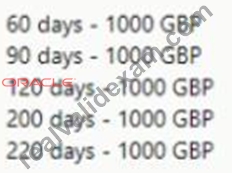
What revenue amount would be deferred on this Imported Invoice?
- A. 0
- B. 1
- C. 2
- D. 3
- E. 4
Answer: E
Explanation:
Explanation
This is the revenue amount that would be deferred on this imported invoice. The Payment Terms Threshold Policy defers revenue recognition of 120 days, which means that only the first two installments (1000 and
4000) are within the threshold and can be recognized as revenue. The remaining three installments (1000,
2000, and 2000) are beyond the threshold and must be deferred until they are due. Verified References: [How You Manage Revenue Recognition - Oracle]
NEW QUESTION # 21
You are asked to amend subledger accounting and reporting to include origin and history of Receivable transactions.
Which three event attributes should be used?
- A. Transaction created by
- B. Transaction creation date
- C. Transaction number of amendments
- D. Transaction last update date
- E. Transaction type of update
Answer: C,D,E
Explanation:
Explanation
These are the three event attributes that can be used to identify the origin and history of Receivable transactions. They capture the information about the changes made to the transactions, such as the transaction number, the type of update (create, update, delete), and the date of the last update. Verified References: [How You Define Event Attributes - Oracle]
NEW QUESTION # 22
Manage Aging Methods
Scenario
Your organization needs to create their own a-bucket aging method for reporting purposes.
Task
Create a new 4-bucket Aging Method in the Collections application, where:
* Name Of the aging method is XXAging Method (Replace XX with 03, which is your allocated User ID.)
* Aging method is accessible to all business units
* Aging buckets are 45 days apart
* Last bucket is 91 days
Answer:
Explanation:
See the explanation below for solution.
Explanation
* Log in to Oracle Financials Cloud.
* Click on the Aging Methods icon in the Receivables work area.
* Click on the Create button.
* In the Aging Method window, enter the following information:
* Name: XXAging Method (Replace XX with your allocated user ID.)
* Description: Custom aging method for reporting purposes.
* Aging Buckets:
* 1: 0 to 45 days
* 2: 46 to 90 days
* 3: 91 to 135 days
* 4: 136 to 180 days
* Last Bucket: 181 days
* Available to All Business Units: Yes
* Click on the Save button.
The new aging method will be created.
NEW QUESTION # 23
Your customer receives their invoices via the XML delivery method. They want to receive billing transactions for specific sites only. Now you have been tasked with creating a very focused delivery method of XML transactions for this customer site that should be receiving the invoice.
To define this setup, you must add a new lookup code to the AR Features lookup type in the Manage Receivables Lookups task. Which lookup code would you use?
- A. AR_NTERFACE.XML
- B. AR.INVOICE.XML.ENHANCED
- C. AR_XML_INVOICE_ENHANCED
- D. AR_CUSTOMER.DELIVERY
- E. AR_XML.DELIVERY.METHOD
Answer: E
Explanation:
Explanation
This lookup code is used to define the XML delivery method for a customer site. You can specify the XML delivery method in the customer profile or in the transaction source. Verified References: [Overview of Oracle Receivables - Oracle]
NEW QUESTION # 24
......
Free 1z0-1056-23 Exam Dumps to Improve Exam Score: https://officialdumps.realvalidexam.com/1z0-1056-23-real-exam-dumps.html
