
Pass Your CFA Level CFA-Level-I Exam Easily with Accurate PDF Questions [Apr 04, 2023]
CFA-Level-I Certification Exam Dumps Questions in here
NEW QUESTION 1191
Vince Inc. changed from the double-declining balance to the straight-line method of depreciation during 20x3. Total depreciation expense for previous years under the double-declining balance method totaled $29,000. Vince Inc. calculated that if the straight-line method had been used, depreciation would have totaled $17,000. Vince Inc. is taxed at a rate of 34 percent. What is the cumulative effect of the accounting change that should be reported on Vince's income statement for the year ended 20x3?
- A. ($12,000)
- B. $7,920
- C. $12,000
Answer: B
Explanation:
If the new accounting method (straight-line) had been used in previous years, Vince's total depreciation expense would have been $12,000 lower ($29,000 - $17,000), and income before income taxes would have been $12,000 higher. Therefore, the cumulative effect of accounting change that should be reported on Vince's income statement for the year ended 20x3 is a positive $7 920 [$12 000x(1-0 34)]
$ 7,920 [$12,000 x (1 0.34)].
NEW QUESTION 1192
Ending inventory is overstated in Period A.
Which of the following occurred as a result of this error?
- A. Retained Earnings at the end of Period B is overstated.
- B. Retained Earnings at the end of Period A is understated.
- C. Retained Earnings at the end of Period B is correct.
Answer: C
Explanation:
The Retained Earnings balance of Period B will be correct. The Period A error caused the net income of Period A to be overstated, therefore, the income of Period B to be understated by that same amount. The Retained Earnings balance will be correct at the end of period B
NEW QUESTION 1193
If a firm has a great deal of inventory built up which of the following ratios would be the largest?
- A. Cash ratio.
- B. Current Ratio.
- C. Quick ratio.
Answer: B
Explanation:
The current ratio is the only one out of the current, cash, and quick ratios that has current assets in the numerator making it the largest of the three ratios.
NEW QUESTION 1194
Economic analysis suggests that patent laws, which can often be used to limit the entry of potential competitors into an industry,
- A. encourage product development and the adoption of cost-reducing technologies in the short run but in the long run generally lead to business monopoly.
- B. may grant temporary monopoly power, but the existence of such laws may also encourage innovation and the development of many items highly valued in society.
- C. may be a source of business monopoly power and they also discourage innovation and the development of cost-reducing production techniques in the long run.
Answer: B
Explanation:
Patents provide inventors with an incentive to conduct research and development in the pursuit of new products and innovations. The incentive is that if the inventor creates a desirable product, he or she will have a monopoly in its production for 17 years.
NEW QUESTION 1195
An analyst has gathered the following information about a company:
110,000 shares of common outstanding at the beginning of the year.
*
The company repurchases 20,000 of its own common shares on July 1.
*
Earnings are $300,000 for the year.
*
10,000 shares of existing 10 percent cumulative $100 par preferred outstanding that is not in
*
arrears at the beginning or ending of the year.The company also has $1 million in 10 percent callable bonds outstanding.
The company has declared a $0.50 dividend on the common.
*
What is the company's basic Earnings per Share?
- A. 3.00
- B. 1.40
- C. 2.00
Answer: C
Explanation:
Interest is already deducted from earnings. (300000 - 100000)/100,000
NEW QUESTION 1196
Which of the following statements describing options is FALSE?
- A. A put option holder's profit increases when the value of the underlying asset increases.
- B. A put option will be exercised only if the market value of the underlying asset is less than the exercise price.
- C. A call option will be exercised only if the market value of the underlying asset is more than the exercise price.
Answer: A
NEW QUESTION 1197
A ______ multiple can be misleading as a valuation indicator when there are significant differences among the level of assets employed by companies.
- A. P/E
- B. P/S
- C. P/B
Answer: C
Explanation:
Such differences may reflect differences in business models.
NEW QUESTION 1198
On January 2, 2002, Heather Ltd. signed a ten-year noncancelable lease for a passenger ferry. The lease stipulated annual payments of $70,000 starting at the end of the first year, with title passing to
Heather at the expiration of the lease. Heather treated this transaction as a capital lease.
The ferry has an estimated useful life of 15 years, with no residual value. Heather uses straight-line amortization for all of its capital assets. Aggregate lease payments were determined to have a present value of $420,000, based on implicit interest of 10%.
In its 2002 income statement, what amount of amortization expense should Heather report from this lease transaction?
- A. $28,000.
- B. $42,000.
- C. $46,667.
Answer: A
Explanation:
The amortization expense would be the present value of the lease divided by the estimated useful life.$420,000 / 15 = $28,000.
NEW QUESTION 1199
The country with a comparative advantage in the production of good X is the one that:
- A. has the greatest technical efficiency in producing good X.
- B. can produce good X at the lowest opportunity cost.
- C. can produce good X with the least labor.
Answer: B
Explanation:
Opportunity cost is the only determinant of comparative advantage.
NEW QUESTION 1200
A bond is currently trading at 98.5 per 100 par, thus yielding 6.21%. It is estimated that the bond price will be 99.4 if rates decreased by 25 basis points and 97.8 if rates increased by 25 basis points. What is this bond's effective convexity?
- A. 0
- B. 1
- C. 2
Answer: A
Explanation:
Convexity = (P- + P+ - 2 P0) / (2 P0 (*r)2) = 162.
NEW QUESTION 1201
If a major magazine contained a review of your restaurant saying it was the best in the Midwest, which of the following would most likely happen?
- A. quantity demanded would increase.
- B. demand would increase.
- C. quantity demanded would drop.
Answer: B
Explanation:
Anything that affects demand other than price will result in a shift in demand. In this case price has not changed. At each price, more of your restaurant services would be demanded; demand would increase.
NEW QUESTION 1202
An estimator is efficient if:
- A. no other unbiased estimator of the same parameter has a sampling distribution with smaller variance.
- B. the expected value of the estimate equals the population parameter.
- C. the estimator gets better as we use more data.
Answer: A
Explanation:
An estimator is efficient if no other estimator of the same parameter has a sampling distribution with a smaller variance.
NEW QUESTION 1203
The goal of an investor following a risk management strategy is to:
- A. control or reduce risk even though doing so will increase expected return
- B. control or reduce risk even though doing so will decrease expected return
- C. increase risk because doing so will increase expected return
Answer: B
Explanation:
Risk management or hedging seeks to reduce risk. In a well-functioning market, decreased risk is associated with decreased expected return.
NEW QUESTION 1204
The firm's short-run supply curve is:
- A. the marginal cost curve above average variable cost.
- B. the marginal cost curve.
- C. the marginal cost curve above average total cost.
Answer: A
Explanation:
The marginal cost curve shows what quantity the firm will produce, given that price is at least equal to minimum average variable cost. Below minimum average variable cost, the firm supplies zero in the short run.
NEW QUESTION 1205
Consider the following transactional information for the investment account of an underwriting syndicate:
1 st Quarter Ending portfolio value: $50,800,000 Total amount invested: $46,100,000
2 nd Quarter Ending portfolio value: $51,100,000 Total amount invested: $50,800,000
3 rd Quarter Ending portfolio value: $51,000,000 Total amount invested: $51,100,000
4 th Quarter Ending portfolio value: $54,500,000 Total amount invested: $50,000,000
Using this information, what is the annual time-weighted rate of return for this portfolio? Assume no taxes or transaction charges.
- A. 20.59% per year
- B. 19.59% per year
- C. 22.14% per year
Answer: A
Explanation:
The time-weighted rate of return is the preferred method of return calculation in the investment management industry, primarily because this method is not sensitive to significant additions and withdrawals of funds from portfolios under examination. The calculation of the time-weighted rate of return involves three steps, which are illustrated as follows:
Step 1:Price the portfolio immediately prior to any significant additions or withdrawals. Separate the portfolio into a series of sub-periods based on the dates of cash inflows and outflows.
Step 2:Calculate the holding period return for each sub-period.
Step 3:Determine the annualized holding period return by linking or compounding the holding period return of each sub-period. If the investment is for more than one year, use the geometric mean of the annual returns as the time-weighted rate of return. If the investment is for less than one year, compound the sub-period returns to obtain an annualized measurement.
To begin the process of determining the time-weighted rate of return, we would break the portfolio up into the subsequent series of cash flows. However, in this example, the cash flows are already aggregated for us and we can move on to the next step: determining the holding period return for each sub-period. This process is detailed as follows:
Quarter 1 holding period return = [($50,800,000 ending value - $46,100,000 invested) / $46,100,000 invested] = 10.19523%
Quarter 2 holding period return = [($51,100,000 ending value - $50,800,000 invested) / $50,800,000 invested] = 0.59055%
Quarter 3 holding period return = [($51,000,000 ending value - $51,100,000 invested) / $51,100,000 invested] = (0.1957%)
Quarter 4 holding period return = [($54,500,000 ending value - $50,000,000 invested) / $50,000,000 invested] = 9.00%
Now that the holding period return for each sub-period has been determined, we must annualize the return measure by taking the product of all four quarterly returns. This process is illustrated below:
[(1 + .10195) * (1 + .00591) * (1 - .00196) * (1 + .09) - 1] = .2059 or 20.59%
When calculating the time-weighted rate of return, remember that the total amount invested is the relevant figure, not the beginning portfolio value. Notice that during the fourth quarter, the total amount invested does not equal the ending amount for the third quarter. This differential could be explained by numerous phenomena. Perhaps the difference is due to a cash withdrawal from the account. Maybe it was used to pay expenses or meet an outstanding margin call. What is important to note is the fact that this money was not invested, and should not be included in the holding period return for the fourth quarter. So said, whenever possible you should use the total amount invested rather than the beginning portfolio value in the calculation of the sub-period holding period return. If you chose 19.59%, remember that in the calculation of the time-weighted rate of return, it is the geometric mean that is used rather than the arithmetic mean.
NEW QUESTION 1206
U.S. GAAP requires that inventories are:
- A. stated at replacement value.
- B. stated either at cost or market value, but the company must be consistent in which method they use.
- C. stated at lower of cost or market.
Answer: C
Explanation:
Inventories must be stated at lower of cost or market value. Market value is defined as replacement cost.
NEW QUESTION 1207
Inventory can be written down to the lower of cost or market value if its value declines due to:
I). obsolescence.
II). price-level changes.
III). damage.
IV). any reason.
- A. I and II only.
- B. I and III only.
- C. I, II, III, IV.
Answer: C
Explanation:
The inventory should be written down to reflect the loss if its value declines below its original cost for whatever the reason.
NEW QUESTION 1208
Reclassification of capitalized interest as an expense will have the following balance sheet effect:
- A. Reduction in capitalized asset by the product of (1 - Tax rate) and capitalized interest adjustment.
- B. Decrease in deferred tax liability by the change in capitalized interest.
- C. Reduction in shareholders' equity by the product of the change in capitalized interest and (1 - Tax rate).
Answer: C
Explanation:
By treating capitalized interest as an expense, net income will be reduced by the amount of capitalized interest with a tax saving of the capitalized interest multiplied by the tax rate. The net is given by, Reduction in shareholders' equity = (1 - Tax rate) x Capitalized interest
NEW QUESTION 1209
Each salesperson in a large department store chain is rated either below average, average, or above average with respect to sales ability. Each salesperson is also rated with respect to his or her potential for advancement either fair, good, or excellent.
These traits are the 500 salespeople were cross classified into the following table.
Sales Ability Potential for Advancement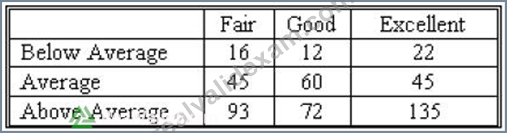
What is the probability that a sales person selected at random will have below average sales abilityand fair potential for advancement?
- A. 0.16
- B. 0.10
- C. 0.032
Answer: C
Explanation:
Prob. of selecting a below average person: (16 + 12 + 22)/500 = 1/10. Prob. of selecting fair potential amongst those in the below average group: 16/50 = 8/25. Therefore 1/10*8/25 = 4/125.
NEW QUESTION 1210
......
Updated CFA-Level-I Exam Practice Test Questions: https://officialdumps.realvalidexam.com/CFA-Level-I-real-exam-dumps.html
