
Workday-Pro-Time-Tracking Questions PDF [2026] Use Valid New dump to Clear Exam
Passing Workday Workday-Pro-Time-Tracking Exam Using 2026 Practice Tests
Workday Workday-Pro-Time-Tracking Exam Syllabus Topics:
| Topic | Details |
|---|---|
| Topic 1 |
|
| Topic 2 |
|
| Topic 3 |
|
| Topic 4 |
|
| Topic 5 |
|
NEW QUESTION # 16
How are Time Tracking Calculations assigned to workers?
- A. They are added directly to the worker upon hire or job change.
- B. They are added to the Time Entry Template.
- C. They are added to Time Calculation Groups where eligibility is assigned.
- D. They are added to the worker's Supervisory Organization.
Answer: C
Explanation:
The correct answer is C. They are added to Time Calculation Groups where eligibility is assigned .
In Workday Time Tracking, individual time calculations are not assigned directly to workers one by one .
Instead, calculations are bundled into a Time Calculation Group , and that group is then associated with workers through eligibility rules . This design allows organizations to manage calculations efficiently for groups of workers who share the same overtime, premium, shift, or regulatory rules.
For example, one worker population may need standard weekly overtime calculations, while another may require California daily overtime, double time, and seventh consecutive day rules. Rather than assigning each calculation directly to each worker, Workday places those calculations into the appropriate Time Calculation Group and uses worker eligibility criteria to determine who receives that group.
Option A is incorrect because a Time Entry Template controls how workers enter time, not which calculations process the time. Option B is incorrect because calculations are not typically assigned directly to the worker record during hire or job change. Option D is incorrect because a Supervisory Organization may help drive eligibility logic, but calculations are not assigned there as the delivery mechanism.
Therefore, in Workday, Time Tracking Calculations are assigned through Time Calculation Groups with eligibility rules , making C the correct answer.
NEW QUESTION # 17
A worker's Work Schedule Calendar has a Day Breaker of 2:00 AM (current day from previous day). They report regular hours from 8:00 PM, April 05 to 4:00 AM, April 06.
How will the calculated hours show on the time block?
- A. Two regular hours on April 05 and six regular hours on April 06.
- B. Four regular hours on April 05 and four regular hours on April 06.
- C. Six regular hours on April 05 and two regular hours on April 06.
- D. Eight regular hours on April 05 and no regular hours on April 06.
Answer: C
Explanation:
The correct answer is D. Six regular hours on April 05 and two regular hours on April 06 .
In Workday Time Tracking, a Day Breaker determines when one workday ends and the next workday begins for time calculation purposes. When the Day Breaker is set to 2:00 AM , any time worked before 2:00 AM is treated as belonging to the previous day , and any time worked at or after 2:00 AM belongs to the current day .
In this example, the worker enters time from 8:00 PM on April 05 to 4:00 AM on April 06 , which equals 8 total hours . These hours split as follows:
* 8:00 PM to 12:00 AM = 4 hours on April 05
* 12:00 AM to 2:00 AM = 2 hours, but because of the 2:00 AM Day Breaker, these hours still belong to April 05
* 2:00 AM to 4:00 AM = 2 hours that belong to April 06
That produces:
* 6 regular hours on April 05
* 2 regular hours on April 06
The key concept is that Workday does not simply split time at midnight when a Day Breaker is defined.
Instead, it uses the configured Day Breaker to assign hours to the proper workday for scheduling, calculations, and reporting.
NEW QUESTION # 18
You have configured a Time Entry Code and assigned a default calculation tag of Callback Guaranteed Time.
What happens when a worker reports time using this Time Entry Code?
- A. The hours are tagged to the default Time Entry Code identified in the Time Entry Template.
- B. The hours are tagged with the Time Calculation Tag applied in the worker's Work Schedule Calendar.
- C. The hours are paid at time and a half the worker's hourly rate.
- D. The hours are tagged with the Callback Guaranteed Time Calculation Tag.
Answer: D
Explanation:
The correct answer is D. The hours are tagged with the Callback Guaranteed Time Calculation Tag .
In Workday Time Tracking, when a default calculation tag is assigned to a Time Entry Code , that tag is automatically applied to time reported with that code unless other calculation logic changes the outcome. This means the time entry itself carries the designated calculation tag into the time calculation process. In this case, if the Time Entry Code has a default calculation tag of Callback Guaranteed Time , then any hours entered using that code will be tagged with Callback Guaranteed Time .
This setup is commonly used to ensure specific kinds of time are consistently identified for later calculation logic, such as guaranteed callback minimums, premiums, or special pay treatment. The tag itself does not automatically determine the pay rate; instead, it marks the hours so the relevant time calculations can recognize and process them correctly.
Option A is incorrect because the worker's Work Schedule Calendar does not control the default calculation tag placed on a Time Entry Code. Option B is incorrect because the Time Entry Template does not retag the reported time to another default code in this way. Option C is incorrect because assigning a calculation tag alone does not directly guarantee payment at time and a half; pay outcomes depend on downstream calculation and payroll configuration.
NEW QUESTION # 19
Refer to the following scenario to answer the question below.
You have received a requirement to create a set of Time Tracking Components for workers who have the following attributes:
* Time Type = Salary
* Country = United States
* Supervisory Organization = Facilities Group
You determine that a weekly period schedule exists that will meet these requirements.
How do you assign this weekly period schedule to this group of workers while not impacting other workers using this period schedule for Time Tracking?
- A. Create a separate duplicate period schedule and remove the existing worker eligibility rule from the original schedule.
- B. Create a new eligibility rule using the Copy Condition from Rule option and use an OR operator to apply the conditions.
- C. Create a new period schedule using the same name as the existing period schedule and apply the new Time Tracking Eligibility Rule in the Worker Eligibility field.
- D. Add a new eligibility rule to the existing period schedule in the Worker Eligibility field, leaving the current rule in place.
Answer: B
Explanation:
The correct answer is B. Create a new eligibility rule using the Copy Condition from Rule option and use an OR operator to apply the conditions .
In Workday Time Tracking, a period schedule is assigned through its Worker Eligibility configuration. If a weekly period schedule already exists and should also apply to a new group of workers, the best practice is not to create a duplicate schedule unless the schedule definition itself is different. Since the schedule already meets the business need, the right approach is to expand the eligibility logic so both the existing worker population and the new worker population can qualify for the same period schedule.
Using Copy Condition from Rule allows you to preserve the existing eligibility criteria and then extend the logic cleanly. The OR operator is important because it lets Workday assign the same schedule to workers who meet either the old rule or the new rule. This avoids disrupting existing workers while adding the new targeted group.
Option A is incorrect because the Worker Eligibility setup does not work as separate parallel rules simply
"left in place" that way; the logic typically needs to be consolidated correctly. Option C is incorrect because creating another schedule with the same name is not the proper solution. Option D would unnecessarily disrupt the current setup.
So the correct answer is B .
NEW QUESTION # 20
What security group assignment does Workday use to run the Mass Operations Management (MOM) function?
- A. Payroll Partner
- B. Manager
- C. Business Process Administrator
- D. Time Tracking Administrator
Answer: D
Explanation:
The correct answer is D. Time Tracking Administrator .
In Workday Time Tracking, the Mass Operations Management (MOM) function is used for administrative actions that affect time tracking data in bulk. Because this is a specialized time administration capability, Workday assigns access to this function through the Time Tracking Administrator security role. This role is intended for users who manage time tracking setup, monitor processing, perform corrections, and run administrative operations across groups of workers or time periods.
Mass operations can have broad impact, so Workday restricts them to a role specifically aligned with time administration responsibilities. That is why the MOM function is not typically assigned to more general roles such as Manager or Payroll Partner . Managers are focused on supervising workers and approving time, while Payroll Partners are responsible for payroll-related processes rather than direct time administration tools. Business Process Administrator handles business process maintenance and oversight, but MOM in this context is tied specifically to Time Tracking administration.
Since the question asks which security group assignment Workday uses to run MOM in the Time Tracking area, the most accurate answer is Time Tracking Administrator . This role provides the correct level of access and responsibility for performing large-scale time tracking administrative operations safely and appropriately.
NEW QUESTION # 21
You need to count all hours in a week of system-generated time blocks for breaks.
What business object will you use?
- A. Worker
- B. Time Week
- C. Time Day
- D. Time Block
Answer: B
Explanation:
The correct answer is B. Time Week .
In Workday Time Tracking, the business object you choose depends on the level at which the calculation needs to evaluate time . Since the requirement is to count all hours in a week for system-generated break time blocks, the calculation must operate at the weekly level , which makes Time Week the appropriate business object. Time Week is used when Workday needs to total, compare, or evaluate hours across an entire workweek rather than looking at only one block or one day at a time.
This is especially important for time calculations involving accumulated weekly values, such as total break hours, weekly overtime thresholds, or weekly premium eligibility. Because the requirement explicitly says all hours in a week , Workday must evaluate the data in a weekly context, not as isolated entries.
The other options are not correct for this scenario. Time Block is too granular because it evaluates individual entries or blocks of time rather than the total for the week. Time Day would only support daily accumulation, not a full weekly count. Worker is too broad and is typically used for eligibility or worker-level attributes rather than time aggregation logic.
So, for counting break-related system-generated time block hours across a full week, the correct business object is Time Week
NEW QUESTION # 22
Where can you configure daily and weekly totals for a worker's time entry calendar?
- A. Time calculation tag
- B. Time calculation
- C. Time entry template
- D. Time entry code
Answer: B
Explanation:
The correct answer is B. Time calculation . In Workday Time Tracking, daily and weekly totals on a worker's time entry calendar are driven through the Time Calculation framework. Time calculations are used to evaluate entered time and produce results such as totals, overtime, premiums, exceptions, and other rule- based outcomes. When Workday needs to total time across a day or across a week, that logic is configured in a time calculation because calculations define how time is interpreted, accumulated, and processed.
The other options do not control this type of totaling behavior. A time calculation tag is mainly used to organize or identify calculations, not to perform the actual totaling logic. A time entry code identifies the type of time being entered, such as regular hours, training, or on-call time, but it does not define calendar total behavior. A time entry template helps control the layout or default structure for time entry, but it is not where daily or weekly total rules are configured.
So, if the question asks specifically where Workday configures the totals shown for a worker's calendar, the best and correct choice is Time calculation .
NEW QUESTION # 23
What worker population will an administrator commonly use Mass Submit Time for?
- A. Hours-only workers using micro-edit.
- B. Project workers using enter time by type.
- C. Salaried workers adjusting their auto-fill from schedule hours.
- D. In/Out workers who use check-in/check-out functionality.
Answer: C
Explanation:
The correct answer is A. Salaried workers adjusting their auto-fill from schedule hours .
In Workday Time Tracking, Mass Submit Time is most commonly used for worker populations whose time is largely predictable and auto-generated , especially salaried workers who use auto-fill from schedule hours . These workers often have standard scheduled hours and may only make small adjustments before time needs to be submitted. Because their time is generally consistent, administrators can efficiently submit time in bulk for many workers at once, which reduces manual effort and supports period-end processing.
This function is less appropriate for populations with more variable or punch-based time entry. Hours-only workers using micro-edit may still require individual changes that make bulk submission less common. In
/Out workers using check-in/check-out functionality rely on punch data and break patterns, so their entries often need closer review before submission. Project workers using enter time by type usually allocate time across projects, tasks, or worktags, making their time more complex and less suitable for broad mass submission.
Mass Submit Time is most valuable when time entry follows a stable pattern and does not require frequent day-by-day validation. That is why salaried workers with auto-fill from schedule hours are the most common population for this administrative action.
NEW QUESTION # 24
On what Time Tracking component can you configure a worktag as required?
- A. Worktag
- B. Time Calculation tag
- C. Time Entry template
- D. Time entry code
Answer: C
Explanation:
The correct answer is D. Time Entry template .
In Workday Time Tracking, the Time Entry template controls the structure of the time entry experience for a group of workers. This includes what fields appear during time entry, how time is entered, and whether certain information must be provided before a worker can submit time. When a business wants to make a worktag required , that requirement is configured through the Time Entry template , because the template governs the entry rules and data capture requirements presented to the worker.
This is the correct design point because worktags such as cost center, project, grant, or other organizational tracking values are often needed at the point of entry for labor costing, reporting, or downstream payroll and financial processing. By making the worktag required in the template, Workday enforces that workers supply that value whenever they enter qualifying time.
The other options are not the primary place for this setup. A Worktag is the classification object itself, not the entry-rule configuration component. A Time entry code identifies the type of time being reported, such as regular or training time, but it does not generally control whether a worktag is universally required in the entry interface. A Time Calculation tag is used for calculation logic, not for entry field requirements.
So the correct answer is D. Time Entry template .
NEW QUESTION # 25
Refer to the following scenario to answer the question below.
You are reviewing time for a worker in California. The worker has reported hours for the seventh consecutive day and the hours are calculating as configured. This week the worker reported 11 hours on the seventh consecutive day worked. This worker is eligible for double-time on all hours worked over 8 on the seventh consecutive day; however, all 11 hours are tagged as seventh consecutive day hours.
You have created and assigned the Seventh Consecutive Day Double Time time calculation to a time calculation group.
Where on the Seventh Consecutive Day Double Time calculation do you find the hours that count toward seventh consecutive day double time?
- A. Add Tags field
- B. Remove Tags field
- C. Time Calculation Group grid
- D. Include Calculation Tags grid
Answer: D
Explanation:
The correct answer is A. Include Calculation Tags grid .
In Workday Time Tracking, the Include Calculation Tags section determines which hours are evaluated by a specific time calculation. For a rule such as Seventh Consecutive Day Double Time , Workday looks at the hours that already carry certain calculation tags and uses those tagged hours to determine whether the threshold for double time has been reached. In other words, the hours that count toward the seventh consecutive day double-time rule are identified in the Include Calculation Tags grid .
This is different from the Add Tags field, which defines the result of the calculation by specifying the tag that will be added after the criteria are met. The Remove Tags field controls which tags should be removed once the calculation applies. The Time Calculation Group grid is not where the hours are identified; it simply groups related calculations for worker eligibility and execution.
In this scenario, if all 11 hours remain tagged as seventh consecutive day hours instead of splitting after 8 hours, reviewing the Include Calculation Tags grid is essential because it shows exactly which tagged hours Workday is counting toward the threshold. That is the configuration area that determines the hours considered for the seventh consecutive day double-time calculation.
Therefore, the correct answer is A .
NEW QUESTION # 26
You are creating a time block conditional calculation.
What business object can you use to check for adjusted, calculated time?
- A. Time Week
- B. Time Day
- C. Time Block
- D. Time Shift
Answer: C
Explanation:
The correct answer is A. Time Block .
In Workday Time Tracking, a Time Block Conditional calculation evaluates conditions at the individual time entry level . When the requirement is to check for adjusted, calculated time , the relevant information is associated with the actual time block record, because that is where Workday stores the entered time and the calculation outcomes tied to that specific entry. A Time Block is the most granular time-related business object and is the correct object to use when testing whether a block has been adjusted or contains calculated results.
This is important because Time Block Conditional logic is intended to inspect and act on specific time blocks rather than broader summarized periods. If you need to determine whether a worker's time block reflects adjusted calculated time, the evaluation must happen on the Time Block object itself.
The other options are not correct for this use case. Time Shift relates more to shift structure or scheduling context, not the direct record used for conditional evaluation of calculated time. Time Day summarizes time at the day level and is used for daily comparisons or accumulations. Time Week is used for weekly totals and thresholds. Neither Time Day nor Time Week is the right object for checking an individual adjusted, calculated time block.
Therefore, the correct business object is Time Block .
NEW QUESTION # 27
Refer to the following scenario to answer the question below.
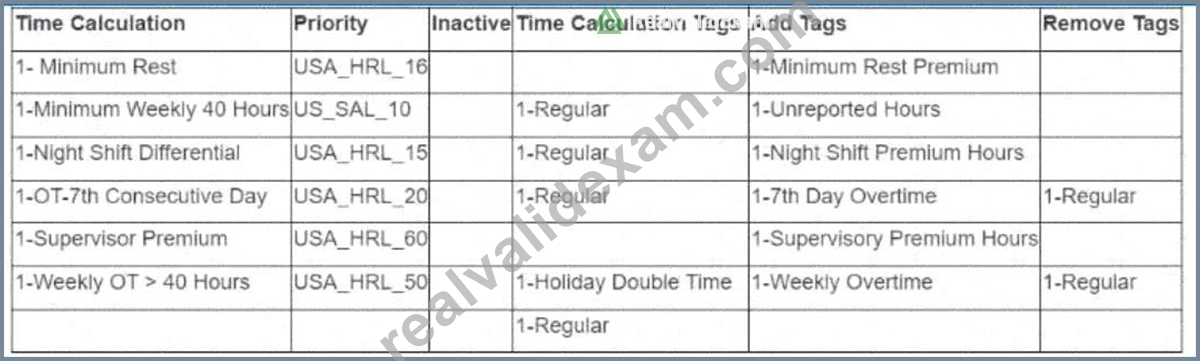
In the report, what calculation has the highest priority?
- A. 1-Minimum Weekly 40 Hours
- B. 1-Minimum Rest
- C. 1-Night Shift Differential
- D. 1-Weekly Overtime
Answer: A
Explanation:
The correct answer is D. 1-Minimum Weekly 40 Hours . In the scenario shown, the Priority column lists the calculation priorities as values such as USA_HRL_16 , USA_SAL_10 , USA_HRL_15 , USA_HRL_20 , and USA_HRL_50 . Among the answer choices, 1-Minimum Weekly 40 Hours has the priority USA_SAL_10 , which represents the highest priority in the report because it carries the lowest priority number shown among the listed options.
In Workday Time Tracking, priorities are important because they determine the sequence in which time calculations are applied. This matters when more than one time calculation can affect the same reported time.
Higher-priority calculations are evaluated first, and their output may influence later calculations such as overtime, premiums, shift differential, or exception handling. That sequencing is essential to avoid overlap, double counting, or incorrect premium generation.
The other options have lower priority values in the report: 1-Night Shift Differential is USA_HRL_15 , 1- Minimum Rest is USA_HRL_16 , and 1-Weekly Overtime is not the highest priority item shown.
Therefore, based on the priority values displayed in the report, the correct choice is 1-Minimum Weekly 40 Hours .
NEW QUESTION # 28
In what time-related business object can you find a True/False condition calculated field for Day of Week = Sunday?
- A. Time Week
- B. Worker
- C. Time Day
- D. Time Block
Answer: C
Explanation:
The correct answer is A. Time Day .
In Workday Time Tracking, when a calculation needs to evaluate a specific day-level attribute such as whether the day is Sunday , the appropriate business object is Time Day . This is because the concept of Day of Week belongs to a single calendar day, and Workday stores day-based evaluation logic on the object that represents an individual day in the time calculation framework.
A True/False condition calculated field for something like Day of Week = Sunday is used when time calculations need to identify specific days for purposes such as weekend premiums, seventh-day rules, special overtime treatment, or other schedule-driven logic. Since the condition is testing one day at a time, Time Day is the correct and most precise object.
The other options are less appropriate. Time Week is used when calculations need to look across an entire week, such as weekly totals or weekly thresholds. Time Block focuses on individual reported or generated entries, not the calendar-day attribute itself. Worker is used for worker-specific attributes and eligibility logic, not for determining the day of week within time calculations.
So, for a True/False calculated field checking whether the day is Sunday, the correct time-related business object is Time Day .
NEW QUESTION # 29
Refer to the following scenario to answer the question below.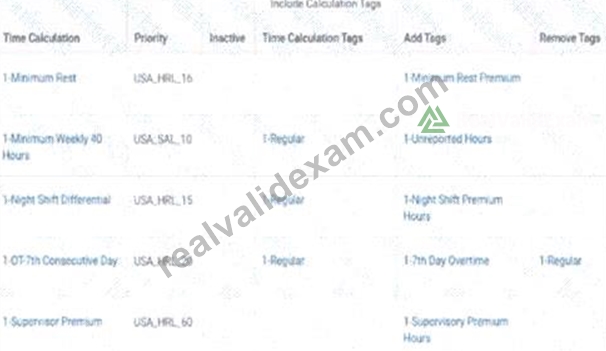

The All Time Calculations task shows the following calculations and priorities:
What is the appropriate priority for the time calculation that creates the 1-Holiday Double Time tag for hourly workers?
- A. USA_HRL_55
- B. USA_HRL_40
- C. USA_SAL_10
- D. USA_HRL_45
Answer: B
Explanation:
The correct answer is B. USA_HRL_40 .
In Workday Time Tracking, time calculation priorities control the sequence in which calculations run . Lower priority numbers run first, and higher numbers run later. The calculation Weekly OT > 40 Hours has priority USA_HRL_50 and explicitly includes the tag "1-Holiday Double Time." This means the system expects the Holiday Double Time tag to already exist before the Weekly OT calculation executes .
Therefore, the calculation that generates the 1-Holiday Double Time tag must run before priority 50 so that the Weekly OT calculation can recognize those tagged hours when it evaluates overtime eligibility.
Looking at the options:
* USA_SAL_10 is used for salaried logic and not appropriate for hourly worker calculations.
* USA_HRL_55 would run after Weekly OT > 40 Hours, which is incorrect.
* USA_HRL_45 would run before 50, but the standard Workday configuration typically places holiday or premium tagging calculations earlier in the sequence so downstream overtime rules can reference them consistently.
Thus USA_HRL_40 is the most appropriate priority because it executes before Weekly OT > 40 Hours (USA_HRL_50) while still allowing earlier calculations such as Night Shift or other hourly rules to run first if needed.
This ensures that Holiday Double Time hours are correctly tagged before weekly overtime calculations evaluate total hours and remove or replace the Regular tag where necessary.
NEW QUESTION # 30
What Time Type do you use to enter elapsed time?
- A. In/Out Time Type
- B. Absence Table Time Type
- C. Time Off Time Type
- D. Hours Only Time Type
Answer: D
Explanation:
The correct answer is B. Hours Only Time Type .
In Workday Time Tracking, elapsed time means entering the total amount of time worked as a number of hours rather than recording specific start and end punch times . That is exactly the purpose of the Hours Only Time Type . It is used when workers report time by duration, such as 8 hours of regular work, 4 hours of training, or 2.5 hours on a project, without providing in and out timestamps.
This differs from the In/Out Time Type , which is used when workers must record actual clock-style entries such as start time, meal breaks, and end time. That method is appropriate for punch-based populations, but it is not considered elapsed-time entry in the way this question is asking. Absence Table Time Type and Time Off Time Type are related to absence and leave reporting, not standard worked time entered as elapsed hours.
The distinction is important in Workday setup because a worker's time entry experience depends heavily on the Time Type assigned through the relevant templates and eligibility rules. If the business wants workers to simply enter the amount of time worked rather than exact punches, the appropriate configuration is Hours Only Time Type .
NEW QUESTION # 31
......
Workday-Pro-Time-Tracking Study Guide Brilliant Workday-Pro-Time-Tracking Exam Dumps PDF: https://officialdumps.realvalidexam.com/Workday-Pro-Time-Tracking-real-exam-dumps.html
